
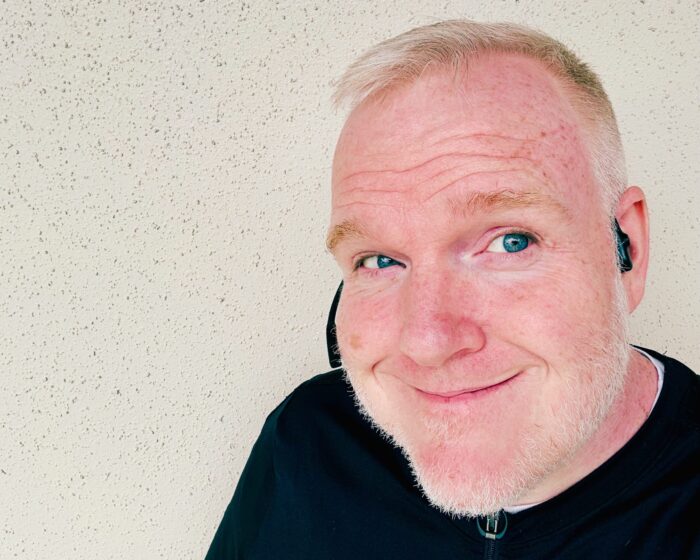
About Dr. Sawyer
Sawyer’s research focuses on optimizing the exchange of information between machine and human. He specializes in performance enhancement and the direction of human attention, in the engineering of textual information, and in preserving the autonomy of human decision-making as artificial intelligence scales. He is Associate Professor of Industrial Engineering and Management Systems at the University of Central Florida, and his greatest satisfaction lies in seeing his work in production systems, helping real people in ways he might never have imagined.
His driving distraction research prompted Google to rebuild their Google Glass driving safety narrative. That first published evaluation of Glass in driving was conducted in collaboration with the Air Force, was covered by media worldwide, and evolved into a general approach to optimizing digital textual information. Sawyer led the creation of and now directs The Readability Consortium (TRC)_, UCF’s first university-industry consortium, where teams backed by Adobe, Google, and Monotype are literally reengineering the technology of the written word. TRC supports a community of over 200 PI-level researchers and leaders from Apple, Microsoft, Amazon, Meta, and others. Prototype systems combining format understanding with LLMs speed readers more than 20% without sacrificing comprehension, with measurable benefits to front-line medical and cybersecurity workers. These findings reach billions of readers in production systems worldwide. Sawyer has briefed the U.S. Senate Committee on Health, Education, Labor, and Pensions on AI technology in education, and his readability work in K-12 classrooms is funded by a $1 million state appropriation.
Sawyer has been in cybersecurity since graduate school. As a Repperger Fellow at the USAF 711th Human Performance Wing he worked in the Applied Neuroscience and BATMAN units alongside Joel Warm, the Senior Scientist at the Air Force Research Laboratory and a foundational figure in vigilance science. That early work on cyber defenders and signal detection led to his prevalence paradox paper with Peter Hancock, which won the Human Factors Prize, the highest research award in the field, and mathematized a fundamental pattern in how humans miss threats in automated and repetitive tasks. The prevalence paradox became the intellectual foundation for the Evil Digital Twin research series at Black Hat, which has drawn standing-room-only audiences and over 20,000 viewers across the 2023 and 2025 briefings, and DEF CON workshops on weaponized LLMs in influence operations. He chairs the Board of the Cognitive Security Institute.
Sawyer earned his MSIE under Waldemar Karwowski and his PhD under Peter Hancock at UCF, with Gerald Matthews and Mustapha Mouloua on his committee and John Senders in the audience. His dissertation received the Outstanding Dissertation Award, and was the basis for his Human Factors Prize-winning paper. He completed his postdoctoral work at the MIT Center for Transportation and Logistics under Joseph Coughlin, founding director of the MIT AgeLab, and advanced to Research Scientist, leading and supporting research into distraction and textual information in automated driving. He was awarded a USAF Young Investigator Award. Sawyer and his teams have contributed over 100 academic outputs to high-impact journals and conferences. His work has been funded by over $5 million in contracts with Fortune 50 companies, DOD and federal grants, consortia dues, state appropriations, and unrestricted gifts. His students and mentees work in industry, government, and academia, at organizations including Google, OpenAI, NASA, Disney, and Lockheed Martin.
Sawyer is a serial entrepreneur with successful exits, including a venture-backed company built at the MIT Engine. He was raised in Montana, the son of a librarian and a professor, without television, reading, riding horses, tending bees, and hunting in the mountains. Before starting college at 27 he worked as a butcher, doing stand-up comedy in the evenings, and later as a travel industry professional. He has visited over 100 countries on six continents, lived in Taiwan studying Mandarin Chinese, and bicycled across Europe.
He’s having fun, and is still not entirely sure what to be if he grows up.
—
Dr Sawyer has since 2010 maintained an anonymous feedback box for kudos, complaints, and kind suggestions.